
Skills mapping. Straight from the people who have the skills.
A company’s skills are not in its job descriptions. They are in its people. Quisquilia interviews all of them, by voice, twenty minutes each. The result is a skills map by department, with the skill gaps and where training will pay off.
Why self-assessment grids fall short.
A questionnaire asks people to rate themselves. Almost everyone gives a fairly high score, and the map you get tells nobody apart.
An interview asks for real episodes. What you did the last time a delivery slipped. How you explained a problem to an angry client. Skills are measured on facts, not opinions.

Michele interviews a project manager
Listening · 05:18
- Tell me about the last time a delivery slipped. What did you do?
- I called the client before he called me. Then I redid the plan with the warehouse.
- How did you decide what to move first?
- I looked at who had the tightest deadlines. I always do that myself. Nobody taught me.
In the reportSetting priorities measured on a real episode, not a score.
How it works.
The framework.
We start from your skills model, even a half-finished file, or we build it with you. The role owner signs it off before we start.
The interviews.
Everyone gets a link and talks when it suits them. The interviewer speaks the language of the department and comes back to the point when an answer stays vague.
The reading.
Every skill is rated on the stories people tell. Every number opens onto the sentences behind it.
The feedback.
Leadership gets aggregate data. Every person gets their own private profile.
What you get.
The screens come from the Output examples. The companies are made up, the results are real in their form. The screens are in Italian.
The skills map.
Hard and soft skills by department and by role. Where the company is strong and where it is exposed.
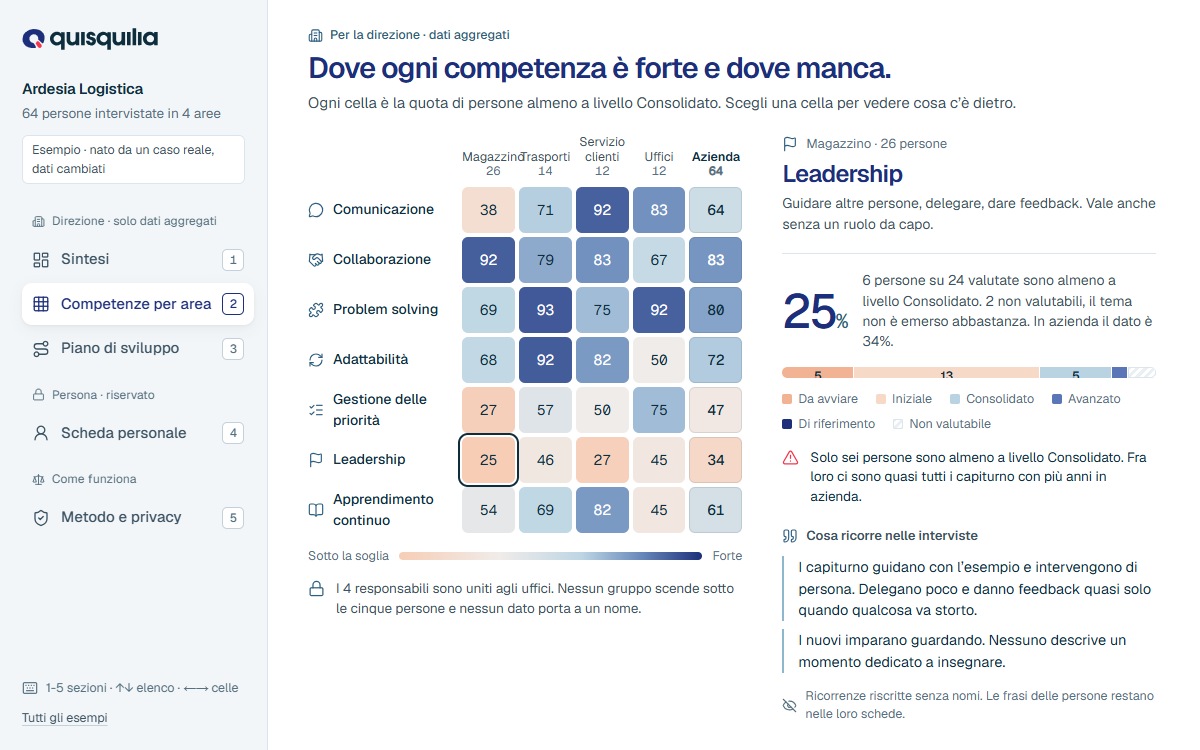
Skills by area The skill gap.
The distance between the skills you need and the skills you have, with training priorities.
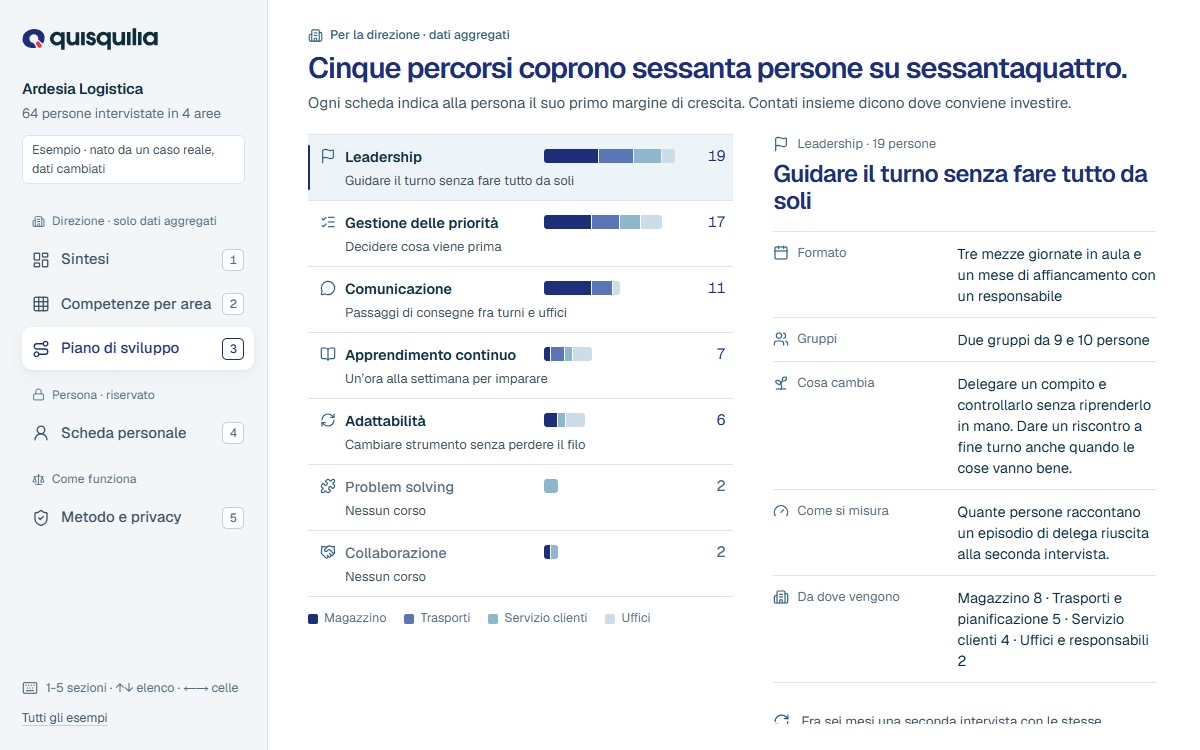
Development plan Skills held by one person.
What only one person can do. It leaves when they leave.
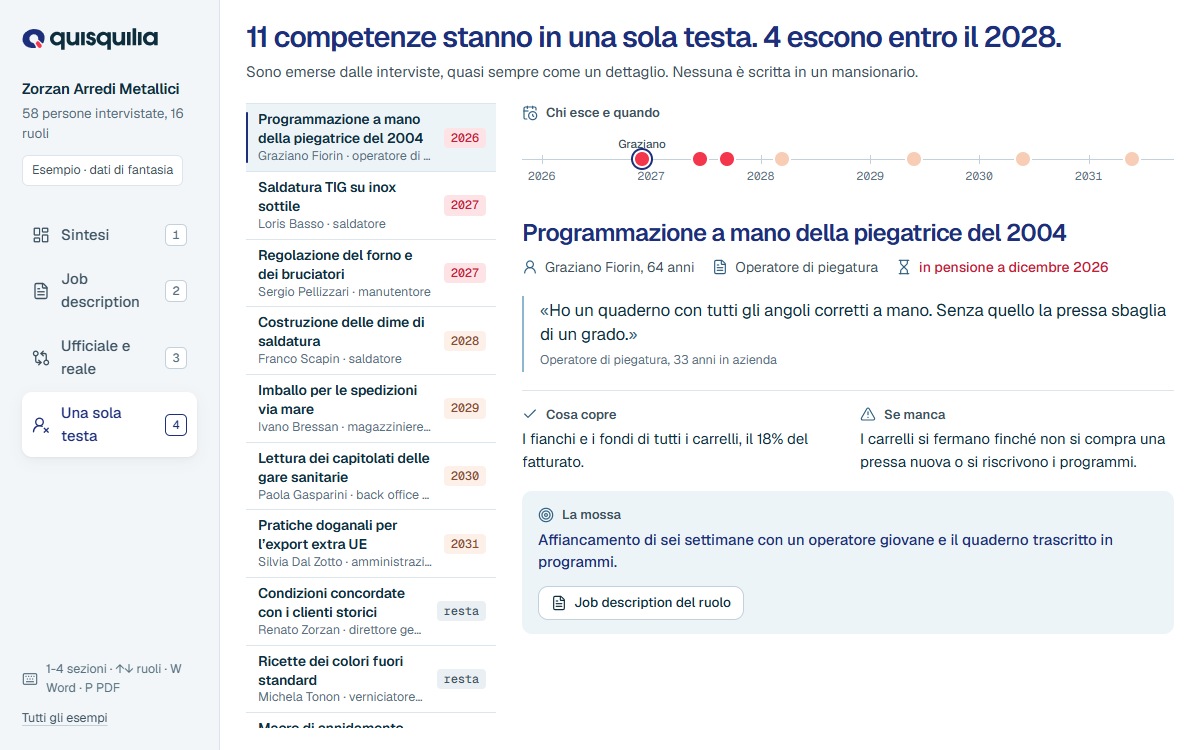
One person only A profile for every person.
Private, with their own words, three actions and a development path.
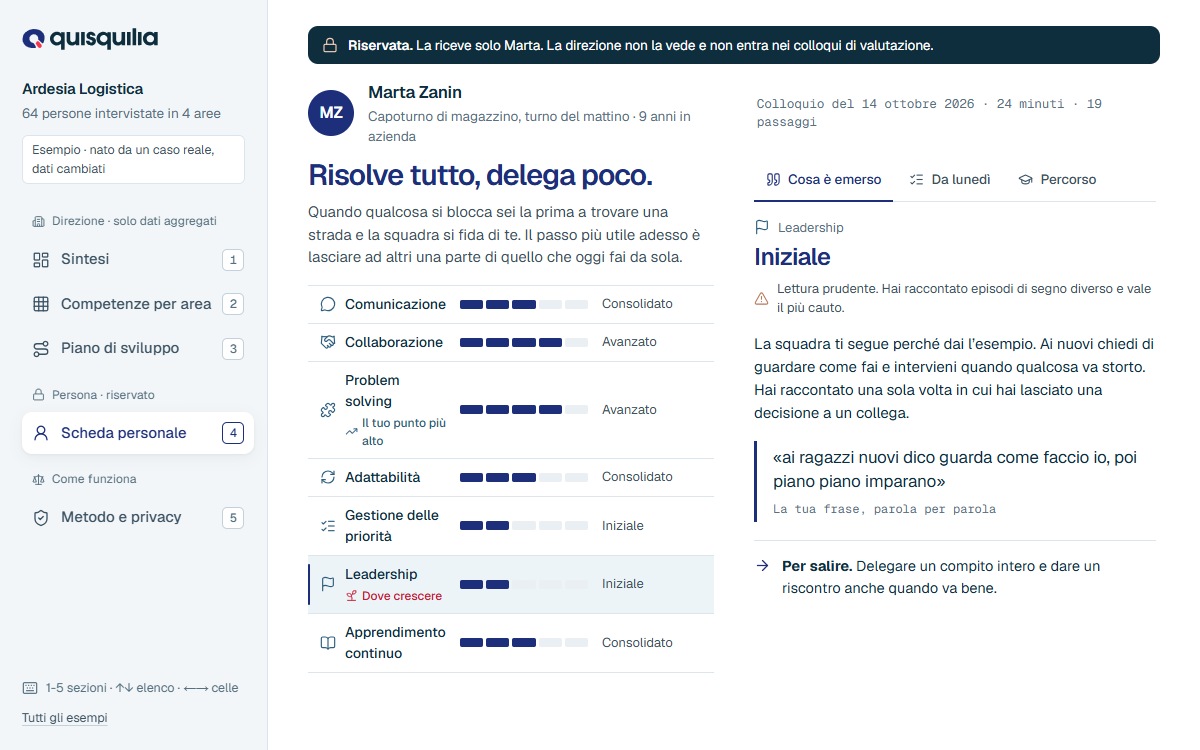
Personal profile
See a full example.
You can open and download them. They are in Italian. All the examples are in Output.
Soft skills (opens in a new tab)
Communication, collaboration and decision making measured on facts, with the development plan.
The real org chart (opens in a new tab)
Who really decides, who people turn to for help and who retires with what.