
Tacit knowledge. What people know and never say.
Tacit knowledge is what a person can do without being able to explain it. The adjustment made by feel. The client to call before the others. The exception no procedure covers. An estimated 80% of a company’s knowledge lives in people’s heads, not in documents.
Tacit vs explicit knowledge.
Explicit knowledge is already written down. Procedures, manuals, data sheets. You can read it, copy it and pass it on.
Tacit knowledge is learned by doing. It is lost when the person who has it leaves, for retirement, for another company or in a generational handover. Often nobody knows they have it until it is missing.

Michele interviews a night shift team leader
Listening · 12:31
- Tell me about a normal night in the warehouse. Where does it start?
- With a round of the cold rooms. I check the temperatures by hand even though there’s an alarm.
- Why by hand, if there’s an alarm?
- Because the alarm goes off late. By then the stock is already at risk.
In the reportManual cold room checks are not in any procedure.
How it works.
The right questions.
We never ask “what do you know”. We ask people to describe a normal night in the warehouse, the last time a machine stopped, what happens when someone is away.
Everyone.
The AI interviewers talk with everyone, ten people or five hundred. Each one when it suits them, even on a lunch break.
Following up.
The interviewer follows the interesting threads and comes back to the point. That is where tacit knowledge comes out.
A form that lasts.
Stories become procedures, job descriptions and maps. Every line links back to the words of the person who said it.
What you get.
The screens come from the Output examples. The companies are made up, the results are real in their form. The screens are in Italian.
Tacit knowledge examples.
The team leader who checks the cold rooms by hand because the alarm goes off late. The salesperson who knows which objection comes back in every deal. The technician who can hear when a part is not right.
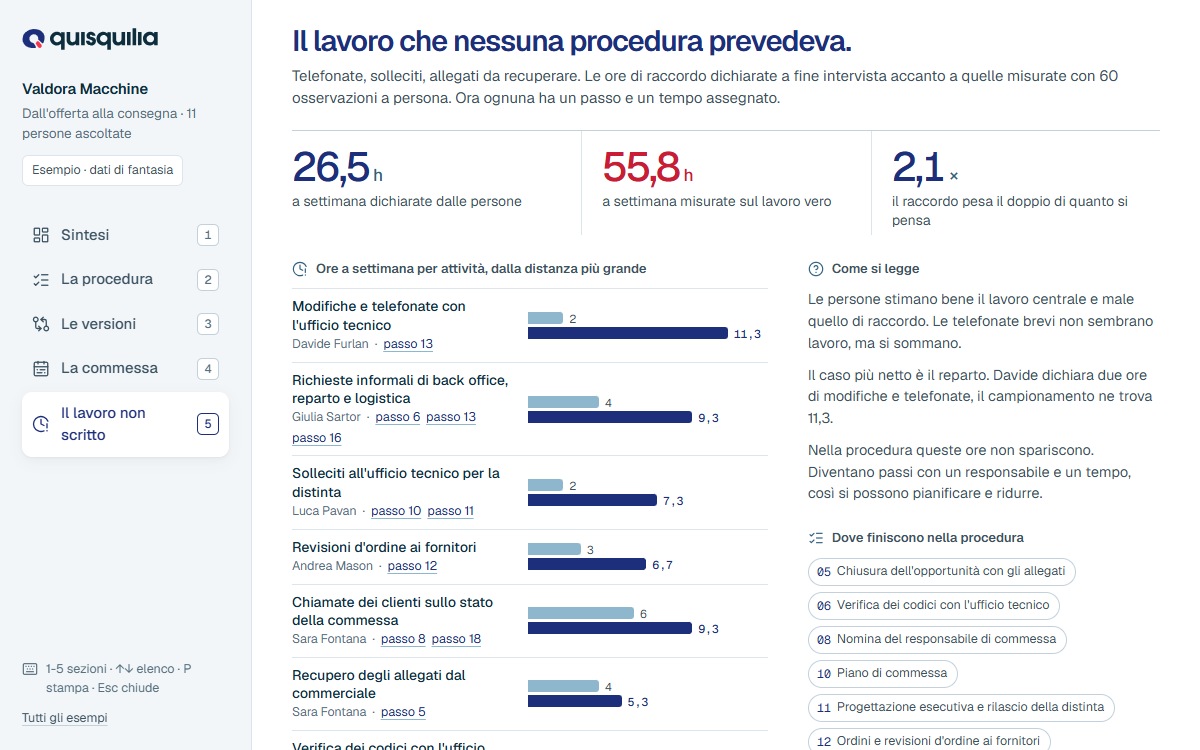
The unwritten work Before people retire.
Who retires in the coming years and what they take with them. Written down while there is still time.
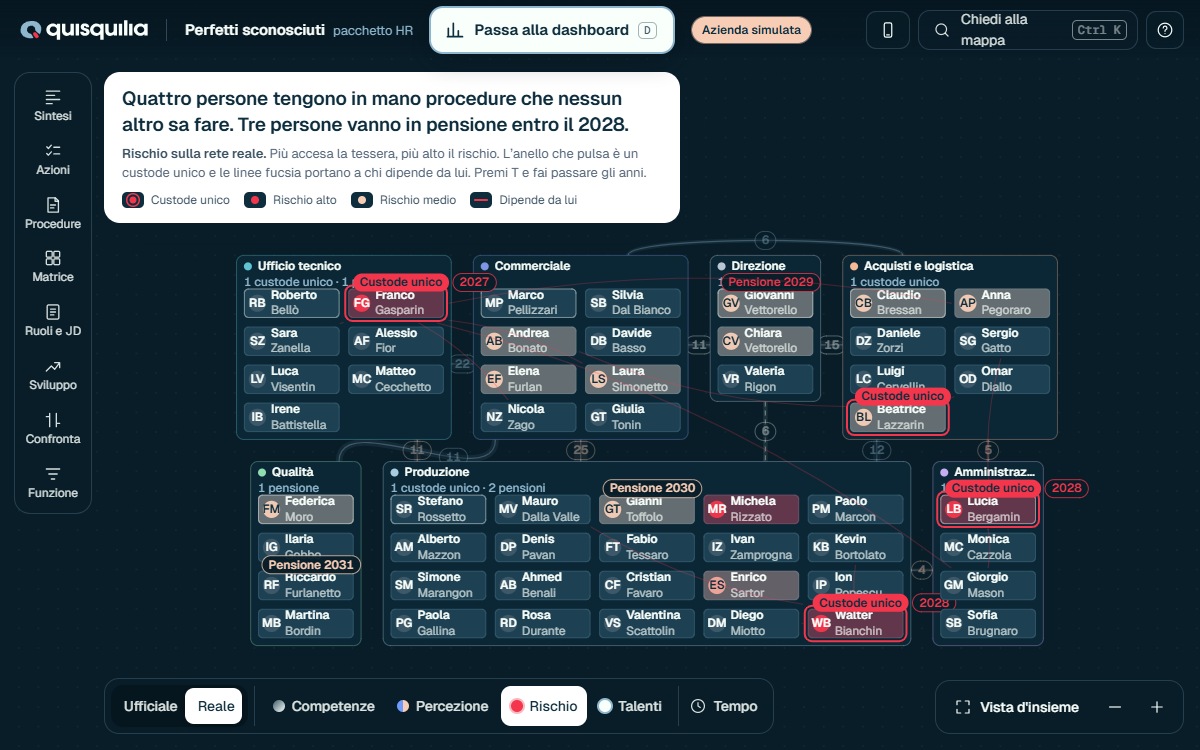
Risk in the org chart In a generational handover.
The experience of the people who founded the company, put into words and turned into something you can pass on.
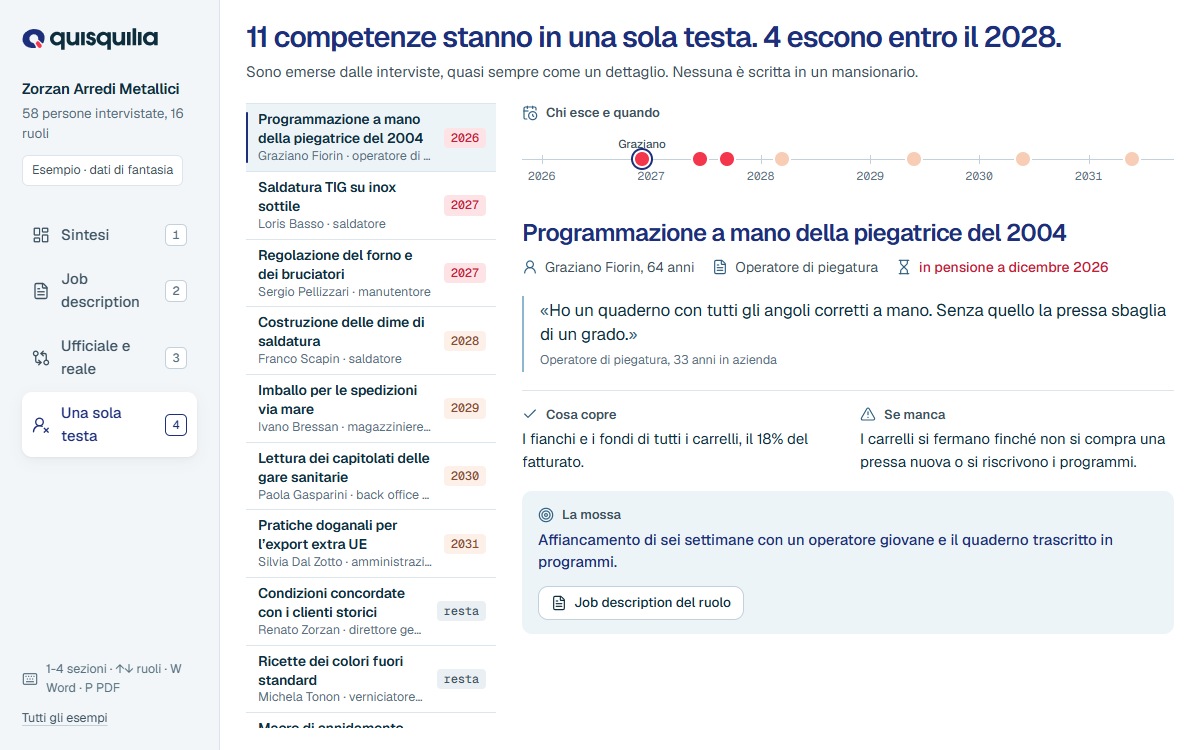
One person only In your processes.
Where people’s versions do not match and which unwritten rule keeps the work going.
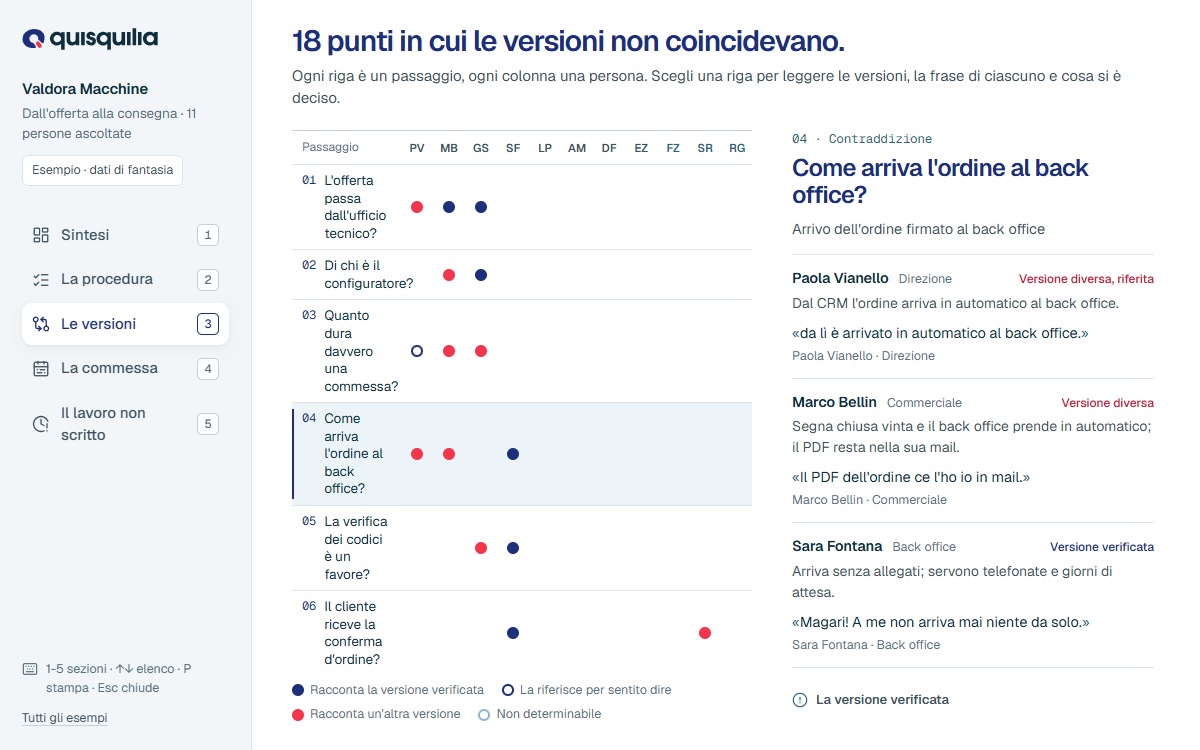
The versions
See a full example.
You can open and download them. They are in Italian. All the examples are in Output.
The real org chart (opens in a new tab)
The people who keep the work going without being managers, and who retires with what.
The procedure (opens in a new tab)
A process told in many versions, written as one.